Backpressure Policy
The backpressure parameter controls what a listener does when the bus
dispatch semaphore is saturated — when all concurrent dispatch slots are in
use. Two policies are available: "block" and "drop_newest".
class PowerApp(App[AppConfig]):
    async def on_initialize(self):
        await self.bus.on_state_change(
            "sensor.power_meter",
            handler=self.on_reading,
            name="power_meter",
            backpressure="drop_newest",
        )

    async def on_reading(self):
        # Under normal load, every reading dispatches.
        # When the global dispatch semaphore is saturated,
        # this event is dropped instead of queuing behind it.
        self.logger.info("Power reading received")
All four bus registration methods — on_state_change, on_attribute_change,
on_call_service, and on() — accept backpressure=.
The Two Policies
block — wait for a slot (default)
block is the default for all listeners. When the semaphore is saturated,
the dispatch loop waits until a slot opens, then runs the handler. No events
are lost; the cost is latency.
Omitting backpressure= is identical to passing backpressure="block".
Existing listeners see no behavior change.
class AlertApp(App[AppConfig]):
    async def on_initialize(self):
        # backpressure="block" is the default — shown here for clarity.
        # This handler always waits for a dispatch slot; it never drops.
        await self.bus.on_state_change(
            "binary_sensor.smoke_detector",
            changed_to="on",
            handler=self.on_smoke,
            name="smoke_alert",
            backpressure="block",
        )

    async def on_smoke(self):
        await self.api.call_service(
            "notify", "persistent_notification",
            message="Smoke detected!",
        )
block is the right policy for handlers that must not miss events — smoke
alarms, audit logs, or any handler where a dropped event leaves the system
in an incorrect state.
drop_newest — skip if saturated
drop_newest skips the event immediately when the semaphore is saturated.
No dispatch slot is acquired, no handler task is spawned, and one drop is
recorded on the listener. The dispatch loop continues to the next listener
without waiting.
class PowerApp(App[AppConfig]):
    async def on_initialize(self):
        await self.bus.on_state_change(
            "sensor.power_meter",
            handler=self.on_reading,
            name="power_meter",
            backpressure="drop_newest",
        )

    async def on_reading(self):
        # Under normal load, every reading dispatches.
        # When the global dispatch semaphore is saturated,
        # this event is dropped instead of queuing behind it.
        self.logger.info("Power reading received")
drop_newest is the right policy for high-frequency, low-value sensors where
missing one reading is acceptable — a power meter updating every 250 ms, a
temperature sensor that bursts readings during a storm. Under normal load,
every event dispatches; the drop only fires when the bus is already saturated.
What "Saturated" Means
The dispatch semaphore is global — shared by all listeners across all
apps. drop_newest does not drop when this listener alone is busy. It drops
when the whole bus has no free slots.
The slot count is set by lifecycle.max_concurrent_dispatches (default 50).
The bus is saturated when that many handlers are in flight at once.
This is different from throttle and debounce, which are per-listener rate
controls that operate inside the handler invoker. backpressure acts at the
acquire gate, before any handler runs.
Non-Obvious Properties
Starvation under sustained load
A drop_newest listener may not run at all while the bus stays saturated.
Every event it receives during a saturation period is dropped. The listener
resumes only once the semaphore clears.
Use block for handlers that must run at least once, even under load.
Fan-out order affects which listener drops
Within a single event, the bus fans out to all matching listeners in sequence.
Each drop_newest listener checks the semaphore at the moment it is reached
in that sequence. A block listener earlier in the fan-out may take the last
slot; a drop_newest listener reached afterward then sees the semaphore
locked and drops.
The effective contract is: "drop if no free slot at the instant this listener is reached." Which listener drops within one event depends on dispatch order: matching listeners run in priority order (highest first), then in registration order for equal priorities.
Signal type: latency vs. silent loss
block converts bus saturation into latency — the operator sees the
dispatch queue grow and can react. drop_newest converts it into silent
loss visible only as a rising drop count.
A non-zero drop count in the monitoring UI means the bus was saturated when
that listener's events arrived. Addressing the root cause — raising
lifecycle.max_concurrent_dispatches, speeding up slow handlers, or reducing
event volume — is preferable to accepting permanent drop rates.
Drop counts are live-only
The drop count resets to zero on every app reload and process restart. The
configured policy is persisted to the database (the listeners table holds
a backpressure column), but the count is not. The monitoring UI's Handlers
tab shows the count for the current process lifetime only.
Observability
The monitoring UI's Handlers tab shows a Backpressure Dropped cell for any listener with a non-zero drop count. The cell pairs the raw count with a rate — drops as a fraction of total activity — so a chronically-dropping listener is visually distinct from one that dropped a single event under a brief spike.
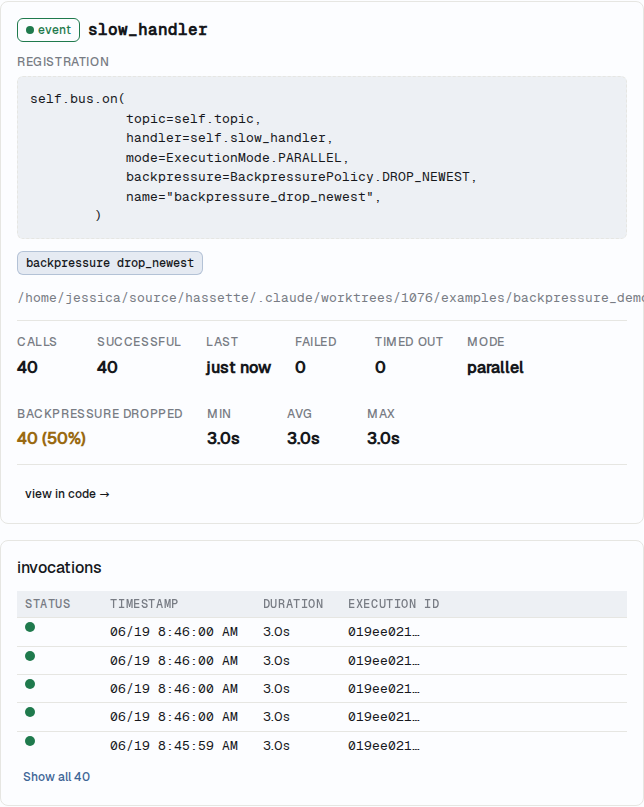
The backpressure_dropped_count field is also available on the listener
summary returned by the web API. A zero drop count at all policy types means
the bus has remained below saturation since the last restart.
Composition
With mode
backpressure and mode operate at different points in
the dispatch pipeline and do not conflict.
backpressuregates at the semaphore acquire — before any task is spawned.modegoverns handler overlap — what happens when a started invocation is still running when the next trigger arrives.
Both can be active at the same time:
class ComposedApp(App[AppConfig]):
    async def on_initialize(self):
        await self.bus.on_state_change(
            "sensor.power_meter",
            handler=self.on_reading,
            name="power_meter",
            backpressure="drop_newest",
            mode="single",
        )

    async def on_reading(self):
        self.logger.info("Power reading received")
A drop_newest listener that passes the semaphore gate still has its overlap
handled by mode. If the handler is still running when the next event arrives
(and that event clears the gate), single drops the re-fire.
With debounce and throttle
debounce and throttle are per-listener rate controls that fire inside the
invoker — downstream of the semaphore gate. A debounced event that clears the
gate then waits the debounce window before dispatching; a saturated gate drops
it before debounce ever runs.
The two mechanisms are independent and do not interfere.
See Also
- Execution Modes:
mode=— handler overlap behavior - Subscription Methods: full parameter reference, including
debounce,throttle,timeout, andif_exists - Debug a Failing Handler: monitoring UI Handlers tab where drop counts appear